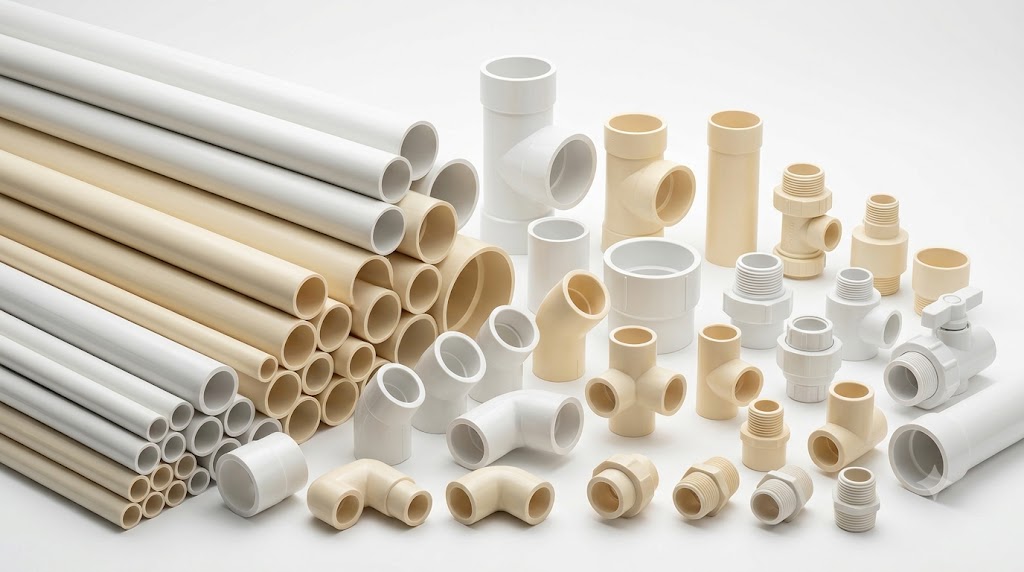

Most plumbing failures in new buildings are not manufacturing defects. They are the result of the wrong pipe being used in the wrong place. The three systems you will handle on almost every job are CPVC, uPVC and SWR, and each exists for a specific reason.
The short version
| System | Carries | Temperature | Pressure rated |
|---|---|---|---|
| CPVC | Hot and cold potable water | Up to about 93°C | Yes |
| uPVC | Cold water supply | Ambient only | Yes |
| SWR | Soil, waste and rain water | Ambient | No, gravity flow |
CPVC: the hot water line
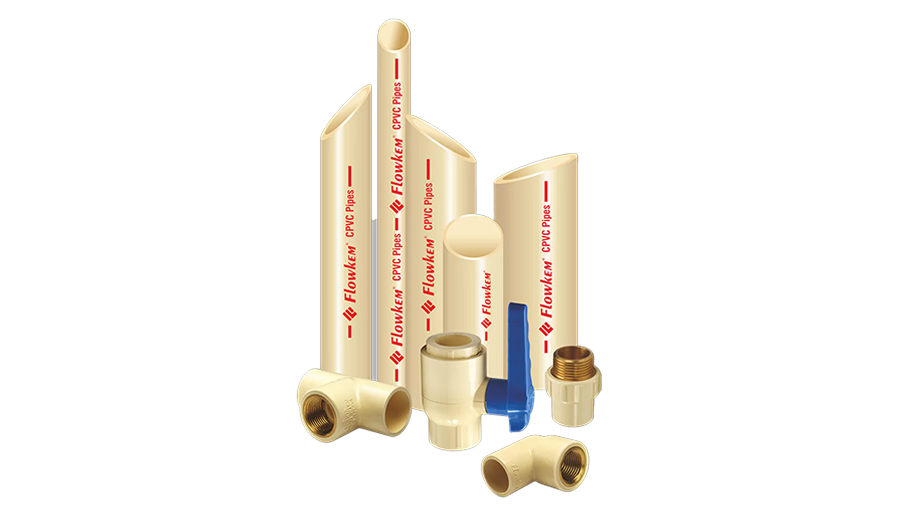
Chlorinated PVC is the only one of the three rated for hot water. It is what should run from your geyser to the bathroom outlets. It is measured by outside diameter in the CTS system, so a half-inch CPVC pipe does not share dimensions with a half-inch uPVC pipe. Fittings are not cross-compatible, and forcing them is a leak waiting to appear behind a wall.
uPVC: cold supply and bore lines
Unplasticised PVC is rigid, pressure rated and completely unsuitable for hot water, where it will soften and deform. It is the right choice for cold water distribution, overhead tank feeds, and with the appropriate wall thickness, for bore well column and casing duty.
SWR: drainage, not supply
Soil, Waste and Rain pipe is a thin-walled, non-pressure system. It moves waste downward under gravity. Using SWR anywhere on a pressurised line will burst it, and using pressure pipe for drainage wastes money on wall thickness you do not need.
Getting the joint right
- Cut square. An angled cut reduces the bonding surface inside the socket.
- Deburr the cut edge so the solvent film is not scraped off on insertion.
- Wipe both surfaces clean and dry before applying solvent cement.
- Apply cement to both the pipe end and the socket, insert with a quarter turn, and hold for thirty seconds.
- Leave the joint undisturbed. Most systems need a full curing period before pressure testing.
Common mistakes worth avoiding
- Using CPVC solvent cement on uPVC or the reverse. The formulations differ.
- Running hot water through a uPVC line to “save cost” on a short run.
- Burying a joint before it has cured.
- Mixing brands mid-run, where tolerances may not match.
Storage
Keep pipes out of direct sunlight before installation. Prolonged UV exposure makes plastic pipe brittle, and a pipe that has sat uncovered through a summer will crack under normal handling.
Specify each system for what it was designed to do and a plumbing installation will outlive the fittings attached to it.
Planning the layout before you cut
Set out the full run on paper before opening a single box of fittings. Every elbow adds resistance, and a line that wanders around obstructions will deliver noticeably less flow at the outlet than a direct route of the same nominal size. Where a change of direction is unavoidable, a long-radius bend disturbs the flow less than a sharp elbow.
Allow for movement. Plastic pipe expands and contracts with temperature, and a hot water line clamped rigidly along its whole length will creak, stress the joints and eventually fail at a fitting. Leave the clips firm but not pinching, and give long straight runs somewhere to move.
Testing before concealment
Pressure test the installation and hold it before any line is chased into a wall or covered by screed. Finding a weeping joint at this stage costs an hour. Finding it after the finishes are complete costs considerably more, and the damage is rarely limited to the pipe itself.