
Buying a pump by horsepower alone is the most common and most expensive mistake in water systems. Horsepower is an input rating. What you actually care about is how much water reaches how high, and that is decided by two other numbers.
The two numbers that matter
Head is the vertical height the pump must lift water, expressed in metres. Discharge is the volume delivered in a given time, usually litres per minute. Every pump has a curve where these two trade against each other: push the head higher and the flow drops.
Calculating total head
- Measure the vertical distance from water level to the outlet.
- Add friction loss in the pipe run, which rises sharply with length and falls with pipe diameter.
- Add losses across each bend, valve and fitting.
- Add any pressure required at the outlet itself.
The total is what the pump must overcome. A pump rated for twenty metres on paper will disappoint on a twenty-metre lift once friction is counted.
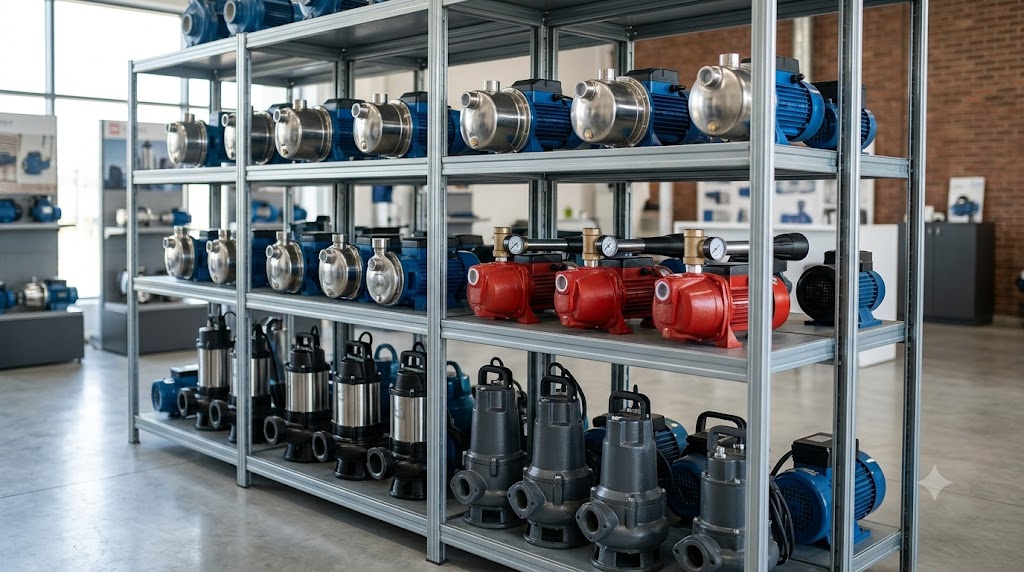
Matching pump type to the job
| Type | Source | Typical application |
|---|---|---|
| Domestic monoblock | Tank or shallow source | Homes, small buildings |
| Pressure booster | Existing supply line | Multi-storey buildings |
| Borewell submersible | Deep bore | Groundwater extraction |
| Openwell submersible | Open well | Wells and surface reservoirs |
| Agricultural | Canal, well or bore | Field irrigation |
| Sewage | Waste sump | Drainage, effluent handling |
| Dewatering | Excavation, pit | Construction sites |
Why oversizing hurts
- Higher running cost for water you did not need moved
- Frequent start-stop cycling, which shortens motor life
- Water hammer in the pipeline from abrupt shut-off
- Cavitation if the pump is starved at the inlet
Installation points that decide service life
Keep the suction line as short and as straight as the layout allows. Fit a foot valve where the design calls for one. Ensure the motor is on a stable, level base, and protect it with correctly rated cable and a starter. A well-selected pump on poor wiring still fails early.
Before you order
Have three things ready: the depth or lift, the pipe run length and diameter, and the flow you need at the outlet. With those, a supplier can match a pump to its curve rather than guess from horsepower.
Selection done properly at this stage is what separates a pump that runs quietly for years from one that gets replaced every second season.
Reading a pump curve
Every pump is supplied with a performance curve that plots discharge against head. The point where your required flow meets your calculated head should sit near the middle of that curve, not at either extreme. A pump running at the far right of its curve is being pushed beyond its efficient range, and one running at the far left is throttled and prone to overheating.
Two pumps with identical horsepower can have completely different curves. That is precisely why horsepower alone tells you very little about whether a pump suits your installation.
Protecting the motor
Dry running is the fastest way to destroy a pump. Where the source can fall below the intake, a level switch or dry-run protection pays for itself the first time the supply is interrupted. Voltage fluctuation is the other common killer, and a correctly rated starter with overload protection guards against both stalled starts and sustained low voltage.
Servicing
Keep a note of the installation date and the rated duty point. When performance drops, comparing current output against that original figure tells you whether the problem is the pump, the pipeline or the source.