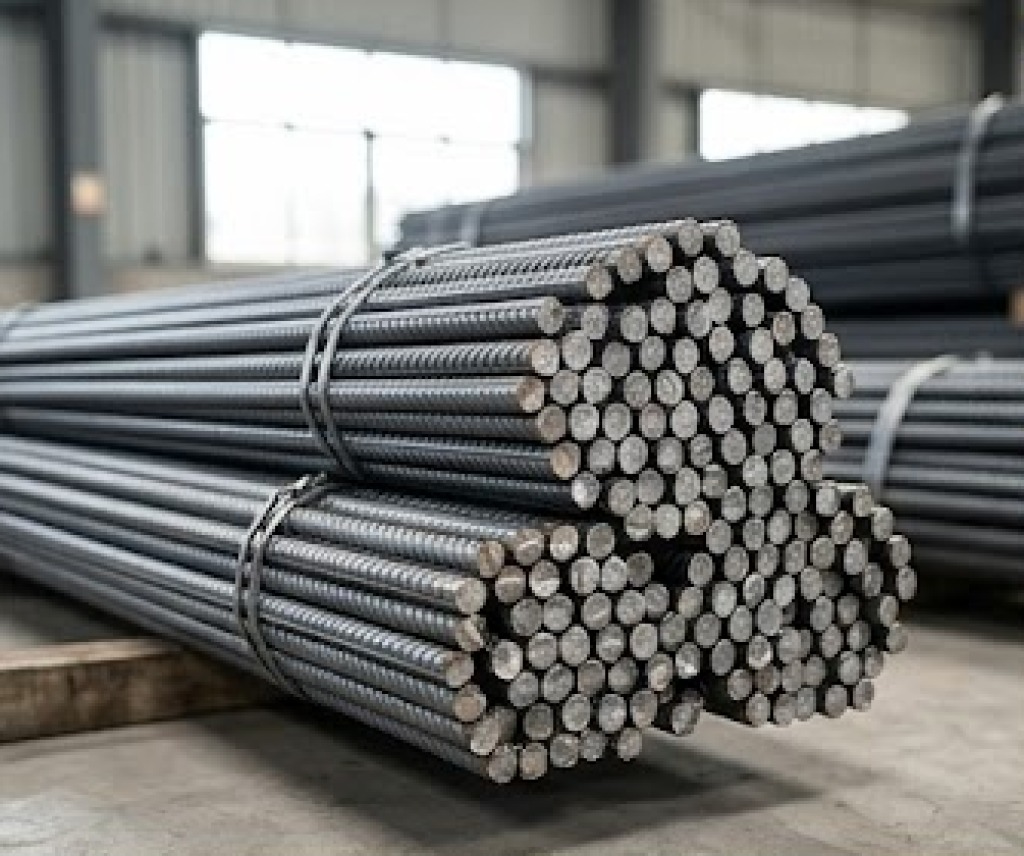

Reinforcement steel is the one material on a site you cannot inspect once it is cast. Choosing correctly at the purchase stage is therefore the only real quality control you get. This guide walks through what actually matters when you order TMT bars.
What TMT actually means
TMT stands for Thermo-Mechanically Treated. After rolling, the bar passes through a water quench that hardens the outer surface while the core cools slowly and stays soft. That combination is what gives a good bar its two useful properties at once: a hard, corrosion-resistant skin and a ductile core that bends instead of snapping.
Reading the grade
Indian TMT bars are graded under IS 1786. The number after “Fe” is the minimum yield strength in newtons per square millimetre.
| Grade | Min. yield strength | Typical use |
|---|---|---|
| Fe 415 | 415 N/mm² | Low-rise homes, boundary walls |
| Fe 500 | 500 N/mm² | Most residential and commercial work |
| Fe 550 | 550 N/mm² | Heavy structures, industrial sheds |
| Fe 600 | 600 N/mm² | High-rise and specialised structures |
A “D” suffix, as in Fe 500D, means higher ductility. In seismic zones that suffix matters more than the raw strength number, because a bar that elongates before failing gives a structure warning time.
Matching diameter to the element
- 6 mm and 8 mm — stirrups, ties and slab distribution steel
- 10 mm and 12 mm — slabs, lintels and light beams
- 16 mm and 20 mm — columns and main beam reinforcement
- 25 mm and above — footings, rafts and heavy industrial bases
Checks to run before you accept a load
- Look for the rolled-in mark. Genuine bars carry the manufacturer name and grade rolled into the rib pattern, not painted on.
- Ask for the mill test certificate and match the heat number on it to the tag on the bundle.
- Bend a sample through 180 degrees. A sound bar shows no cracking on the outer face.
- Check the rib pattern is even along the length. Uneven ribs reduce grip with the concrete.
- Reject any bar with flaking rust. Light surface oxidation is normal and harmless; scaling is not.
Storage on site
Keep bundles off the ground on timber sleepers and under cover if they will sit for more than a few weeks. Bars stacked directly on damp soil will pit along the contact line, and that pitting is exactly where corrosion starts once the bar is in concrete.
A note on price
Reinforcement is sold by weight, so an underweight bar is the most common way buyers lose money without noticing. Weigh a metre length and compare it against the standard sectional weight for that diameter before accepting a large order.
Buy from a distributor who can produce the mill certificate on request. That single document ties the steel in your slab back to a testable batch, which is the difference between a specification and a promise.
Estimating quantity before you order
Reinforcement is usually estimated as a percentage of concrete volume, and the percentage varies by element. Slabs typically fall in the lower range, while columns and footings carry considerably more steel per cubic metre. Working from the bar bending schedule rather than a rule of thumb avoids both shortfall and dead stock at the end of a pour.
Order in the lengths your schedule actually uses. Standard mill lengths cut into awkward remainders generate offcuts that are too short to lap and end up as scrap, and on a large slab that waste adds up quickly.
Lapping and cover
Two details decide whether good steel performs as intended. The lap length must suit the bar diameter and the grade of concrete, and the clear cover must be maintained with proper spacers rather than stone chips. Insufficient cover is the single most common reason reinforcement corrodes in structures that are otherwise sound, because it lets moisture reach the bar far sooner than the design assumed.