
Rolled steel sections all look like variations on the same theme until you understand that each shape is an answer to a specific loading problem. The cross-section decides what the member is good at.
The four families
Beams
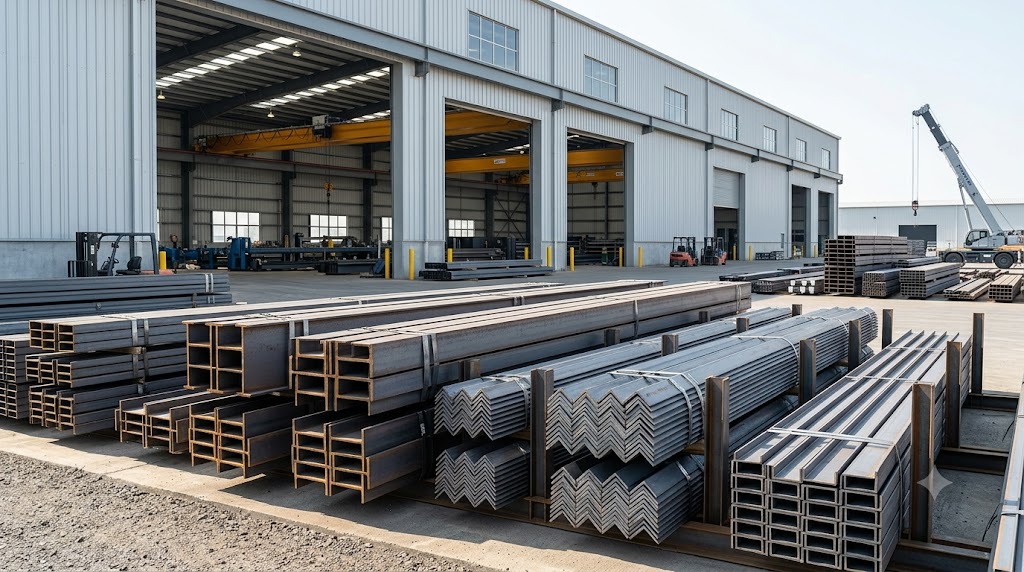
An I-shaped or H-shaped section concentrates material in the top and bottom flanges, where bending stress is highest, and keeps only a thin web between them. That is why a beam is efficient in bending and why it should be loaded on its strong axis. Turn a beam on its side and you lose most of its capacity.
Channels
A C-shaped section with one open side. Channels suit purlins, framing members and edge beams where a flat face is useful for fixing. Because the shape is not symmetrical about the vertical axis, a channel loaded off-centre will tend to twist, so it is usually paired or restrained.
Angles
An L-shaped section, equal or unequal leg. Angles are the workhorse of bracing, trusses and connection cleats. They carry axial load well and are simple to bolt or weld in place.
Plates
Flat stock used for base plates, gussets, stiffeners and cover plates. Plate is where connections between other sections get made.
| Section | Best at | Common use |
|---|---|---|
| Beam (I / H) | Bending | Floor and roof beams, columns |
| Channel (C) | Bending with a flat face | Purlins, framing, edge members |
| Angle (L) | Axial load | Bracing, trusses, cleats |
| Plate | Distributing load | Base plates, gussets |
Ordering without waste
- Work from the fabrication drawing, not from an estimate of running metres.
- Group cut lengths so offcuts fall into reusable sizes.
- Confirm the section designation fully, including depth and weight per metre.
- Ask whether the mill supplies in standard lengths that suit your spans.
Handling and storage
- Stack on level sleepers so sections do not take a permanent set.
- Keep angles and channels from nesting under load, which bends the legs.
- Store off bare soil to slow surface corrosion.
- Lift long members at two points to avoid sag.
Before fabrication
Check the actual delivered section against the drawing. Depth, flange width and weight per metre should all match. A substitution that looks close on site can change the load capacity of the frame it goes into.
Structural steel is unforgiving of guesswork but very predictable when specified properly. Order to the drawing and the frame behaves the way the engineer intended.
Connections decide the frame
A steel frame is only as good as the joints between its members. Bolted connections need the correct grade of bolt, the right hole clearance and adequate edge distance, because a bolt too close to the edge of a plate will tear out under load long before it shears. Welded connections need the specified weld size and continuity, and a weld that looks generous but lacks penetration is weaker than a smaller, properly fused one.
Surface preparation and protection
Steel that will be painted must be cleaned of mill scale and rust first, otherwise the coating bonds to a layer that is itself about to detach. For exposed or humid conditions, galvanising gives far longer service than paint. Where members will be encased in concrete, protection is less critical, but the surface should still be free of loose scale so the concrete grips.
On site
Check members for straightness before erection. A section that has taken a set in storage will not sit true in the frame, and forcing it into position locks stress into the structure before it has carried any load at all.